
Anti-Money Laundering (AML) Policy
Last updated: June 2026
NEMO Interactive Group Corporation (“the Company”), operator of the ArionPlay platform, is committed to preventing the use of the Platform for money laundering, terrorist financing, or any other financial crime. This Anti-Money Laundering Policy (“AML Policy”) sets out the Company’s obligations and procedures under the Philippine Anti-Money Laundering Act (Republic Act No. 9160, as amended by RA 10167, RA 10365, and RA 11521, “AMLA”) and applicable PAGCOR regulations.
All players, transactions, and accounts on the Platform are subject to this AML Policy. By registering an Account, you agree to cooperate with our compliance procedures.
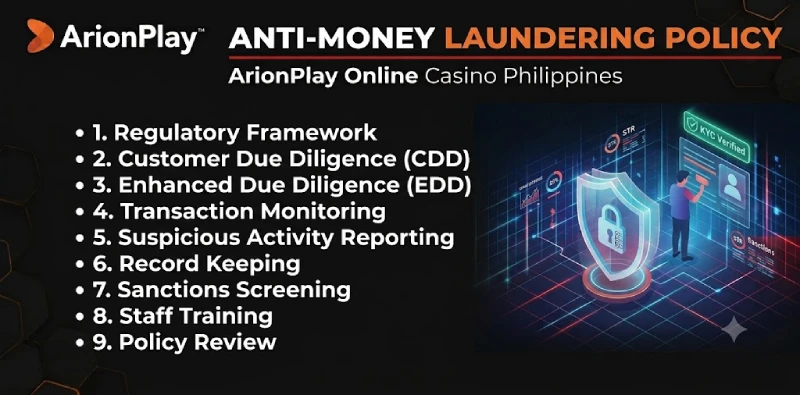
1. Regulatory Framework
The Company operates as a PAGCOR-licensed gambling operator under Brand No. 41, which classifies it as a covered person under the AMLA. As a covered person, the Company is required to implement an AML compliance programme, conduct customer due diligence, monitor transactions, report suspicious activities to the Anti-Money Laundering Council (AMLC), and maintain records for the periods required by law.
The Company’s AML programme is supervised by PAGCOR and the AMLC. Failure to comply with AMLA requirements may result in regulatory sanctions, including fines and licence revocation.
2. Customer Due Diligence (CDD)
The Company applies Customer Due Diligence procedures to all players before and during their use of the Platform. CDD is the process of verifying the identity of a customer and assessing the risk associated with their account and transactions.
Standard CDD applies to all players at registration and before the first withdrawal. It includes collection of the player’s full name, date of birth, and mobile number; verification of identity through a valid Philippine government-issued document (passport, driver’s licence, SSS ID, PhilHealth card, or UMID); and confirmation that the player is not on any sanctions or watchlist maintained by the AMLC or international bodies.
Simplified CDD may apply to lower-risk accounts with limited transaction volumes, where the regulatory framework permits a reduced level of verification.
CDD is an ongoing obligation. The Company may request updated or additional documentation at any point during the life of an Account if risk indicators change or if required by law.
3. Enhanced Due Diligence (EDD)
Enhanced Due Diligence is applied to higher-risk players and transactions. EDD triggers include:
Players identified as Politically Exposed Persons (PEPs) — individuals who hold or have held prominent public positions, or their close associates and family members. Players from jurisdictions subject to heightened scrutiny by the Financial Action Task Force (FATF) or AMLC. Transactions that appear inconsistent with a player’s known profile, occupation, or stated source of funds. Single transactions or cumulative activity within a period that exceeds thresholds set by the AMLC or internal risk parameters. Accounts flagged by automated monitoring systems as exhibiting patterns associated with financial crime.
EDD may include a request for documented proof of source of funds, enhanced transaction monitoring, and escalation to the Company’s compliance officer for review before transactions are processed.
4. Transaction Monitoring
The Company monitors player transactions on an ongoing basis using automated systems designed to detect patterns that may indicate money laundering, structuring, or other financial crime. Monitoring parameters include:
Deposits or withdrawals that approach or exceed reporting thresholds under the AMLA. Multiple deposits or withdrawals within a short period that cumulatively suggest structuring. Significant changes in a player’s transaction pattern relative to historical activity. Deposits followed immediately by withdrawal requests without corresponding gaming activity. Use of multiple payment methods or accounts by a single player without clear legitimate explanation.
When a transaction triggers a monitoring alert, it is reviewed by the Company’s compliance function. The transaction may be delayed, suspended, or declined pending review. Players may be contacted to provide additional information.
5. Suspicious Activity Reporting
The Company is legally required to file a Suspicious Transaction Report (STR) or Covered Transaction Report (CTR) with the Anti-Money Laundering Council (AMLC) when required under the AMLA and its implementing rules.
A Covered Transaction Report is filed for single transactions exceeding the threshold prescribed by the AMLC. A Suspicious Transaction Report is filed when the Company has reasonable grounds to suspect that a transaction, regardless of amount, involves the proceeds of an unlawful activity or is related to terrorist financing.
The Company is prohibited by law from informing any player that a report has been filed in connection with their account or transactions. This obligation (“tipping off” prohibition) is a legal requirement and cannot be waived.
6. Record Keeping
The Company retains records of all customer identification documents, account information, and transaction records for a minimum of five years from the date of the transaction or Account closure, as required by the AMLA. Records are maintained in a format that allows retrieval and production to the AMLC or PAGCOR upon request.
Attempts to tamper with, destroy, or falsify records subject to AMLA retention requirements are treated as serious violations and may be reported to the AMLC.
7. Sanctions Screening
The Company screens all players against applicable sanctions lists, including the AMLC Sanctions List and lists maintained by the United Nations Security Council and Office of Foreign Assets Control (OFAC). Accounts matching or closely matching entries on these lists are suspended immediately pending review. The Company will not provide services to sanctioned individuals or entities.
8. Staff Training
All Company staff who interact with players or handle financial transactions receive AML compliance training at onboarding and on a regular basis thereafter. Training covers recognition of suspicious activity indicators, CDD and EDD procedures, reporting obligations, and the tipping-off prohibition. The Company’s compliance officer is responsible for maintaining and updating the training programme in line with regulatory changes.
9. Policy Review
This AML Policy is reviewed at least annually and updated as required to reflect changes in Philippine law, AMLC guidance, PAGCOR regulations, and FATF standards. Material updates are communicated to relevant staff and recorded in the Company’s compliance register.
For questions about this policy or to provide information relevant to a compliance review, contact ArionPlay support through our Contact page. See also our KYC Verification page and Privacy Policy.